
A Quick Primer on Spring and Spring Boot

The Spring framework was officially released in 2003. It’s a lightweight Java development framework that solves loose-coupling problems between the business logic layer and other layers, and carries interface-oriented programming philosophy through the entire application stack.
Spring’s two core pillars are IoC (Inversion of Control) and AOP (Aspect Oriented Programming). After 20+ years of development, Spring is now in its 6.0 era, though the versions still most commonly deployed domestically are 4.0 and 5.0.
Spring Boot is a curated bundle of Spring components — pre-assembled so you can stand up a Spring-based web system in very little time. The version mapping between the two is:
| Spring Boot version | Spring version |
|---|---|
| 3.x | 6.x |
| 2.x | 5.x |
| 1.x | 4.x |
The source analyzed in this post is based on Spring Boot 2.2.0.RELEASE (corresponding to Spring Framework 5.2.0.RELEASE), with Tomcat as the default web container.
Source-Code Deep Dive: The Full Route-Matching Flow
org.springframework.web.servlet.DispatcherServlet is the core entry point Spring uses to dispatch routes.
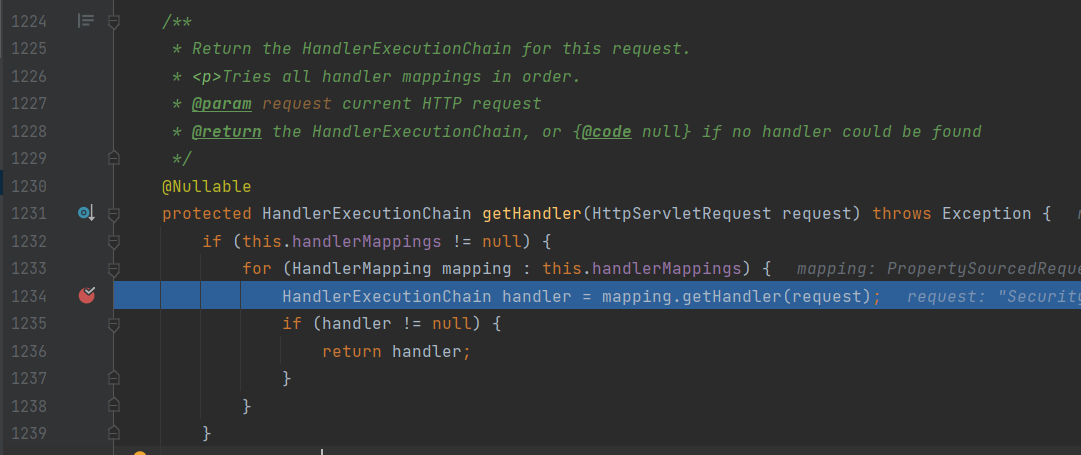
Inspecting this.handlerMappings turns up 8 different HandlerMapping implementations:
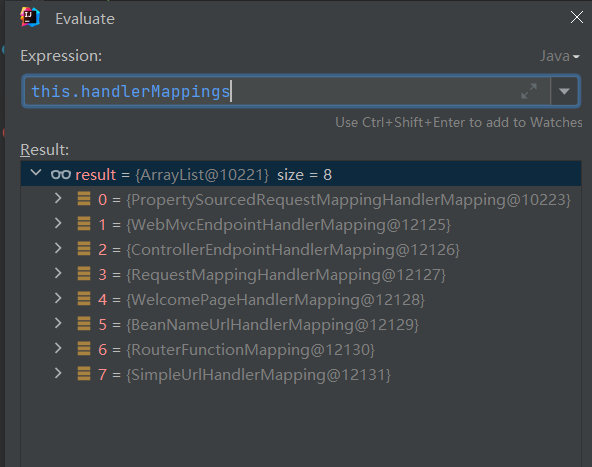
| Class | Purpose |
|---|---|
springfox.documentation.spring.web.PropertySourcedRequestMappingHandlerMapping | Configuration-driven URL handler, e.g. Swagger |
org.springframework.boot.actuate.endpoint.web.servlet.WebMvcEndpointHandlerMapping | Used by the Actuator monitoring framework |
org.springframework.boot.actuate.endpoint.web.servlet.ControllerEndpointHandlerMapping | Used by the Actuator monitoring framework |
org.springframework.web.servlet.mvc.method.annotation.RequestMappingHandlerMapping | Endpoints implemented via the @RequestMapping annotation |
org.springframework.boot.autoconfigure.web.servlet.WelcomePageHandlerMapping | Default welcome-page handler |
org.springframework.web.servlet.handler.BeanNameUrlHandlerMapping | URL handler keyed off bean names |
org.springframework.web.servlet.function.support.RouterFunctionMapping | Function-based URL handler |
org.springframework.web.servlet.handler.SimpleUrlHandlerMapping | Path-expression-based URL handler |
getHandlerInternal → lookupPath
When the mapping is a RequestMappingHandlerMapping, execution enters mapping.getHandler, then getHandlerInternal, and eventually getLookUpPathForRequest.
When alwaysUseFullPath is enabled, Spring looks up the full path. That setting defaults to false on Spring Boot ≤ 2.3.0.RELEASE, in which case execution continues on into getPathWithinApplication → getRequestUri.
The URL Sanitization Chain: decodeAndCleanUriString
decodeAndCleanUriString runs the following processing chain, in order:
removeSemicolonContent— strips;and everything after it from the URL, so/admin;xxxbecomes/admin.decodeRequestString— URL-decodes the path, so/%61%64%6d%69%6ebecomes/admin.getSanitizedPath— collapses redundant/characters, so///adminbecomes/admin.- Strips the application’s context path.
Now look at what’s left of getPathWithinServletMapping: it ultimately calls the web container’s own getServletPath method, whose return value differs across containers. On Tomcat, for example, given the input /api/..;/test, this method returns the normalized URL — /test. In that case getPathWithinServletMapping typically returns an empty string, and the final URL is whatever getPathWithinApplication produced.
lookupHandlerMethod: “Smart” Best-Match
Having walked through how lookupPath is resolved, back in AbstractHandlerMethodMapping.getHandlerInternal: once lookupPath is obtained, execution enters lookupHandlerMethod, which looks up the matching handler method using Spring’s formatted request path. Every HandlerMapping except PropertySourcedRequestMappingHandlerMapping runs this default lookupHandlerMethod logic.
The core of this method is best-match: even when the URL a user requests doesn’t exactly match what’s defined in @RequestMapping, Spring can still “intelligently” infer the intended handler. A classic case: requesting /admin/ will, via closest-match resolution, still hit a route defined as /admin.
Exploitation and Remediation
Scenario 1: Authorizing on getRequestURI / getRequestURL
On Tomcat, the URL obtained via getRequestURI / getRequestURL is the raw request URL — untouched by any processing or transformation. But as the source analysis above showed, Spring automatically strips special characters from URLs and URL-decodes them. So if the authorization logic reads from getRequestURI / getRequestURL while route matching reads from Spring’s processed path, the two can end up with different “interpretations” of the same URL — and that mismatch is exactly what produces an authorization bypass.
Common bypass techniques:
- Inserting junk characters: adding
;,/, etc. into the path. - URL encoding: percent-encoding the path.
- Directory traversal (Spring Boot ≤ 2.3.0.RELEASE): using sequences like
..;/.
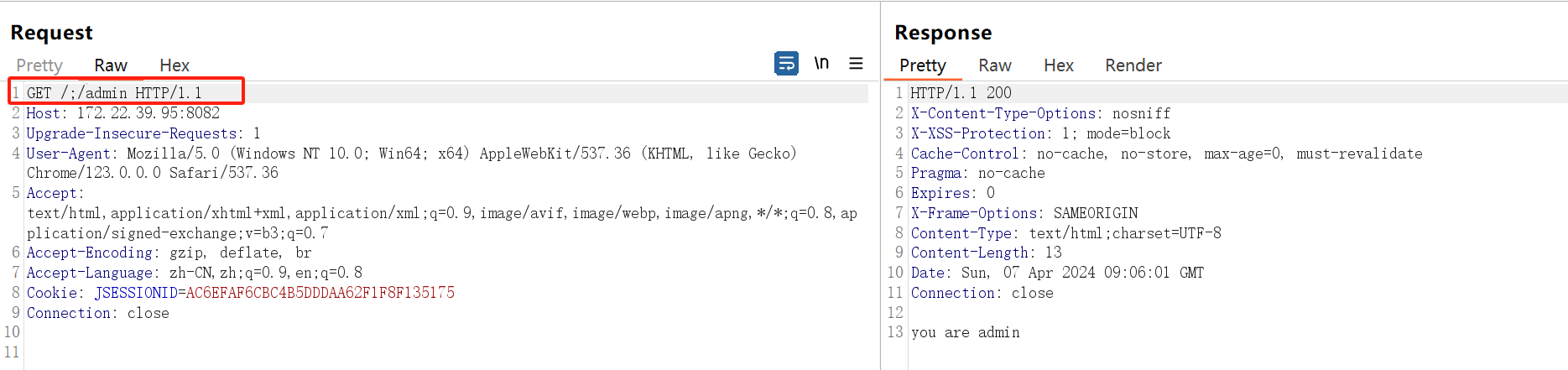
In a local test environment, here’s getRequestURI-based authorization plus a semicolon bypass in practice — a plain request to /admin gets blocked, but inserting a semicolon still returns you are admin:
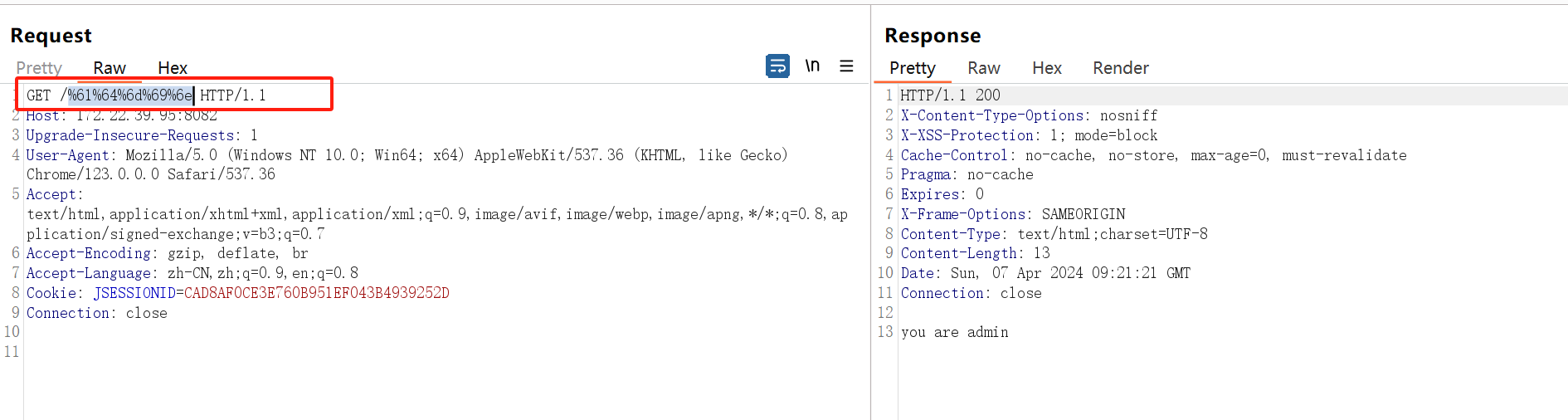
URL encoding works the same way — /%61%64%6d%69%6e decodes to /admin, and bypasses just as easily:
For example, requesting /;//api/../admin produces different results from getRequestURI and getServletPath — the former is the untouched raw string, the latter is Tomcat’s normalized result.
Remediation: prefer getServletPath for obtaining the request path. Its return value has already been normalized by Tomcat, which tracks much more closely with how Spring cleans and transforms paths — avoiding the authorization bypass that results from the two sides disagreeing.
Scenario 2: Loose URL Blacklist Validation
Because Spring’s “best route match” algorithm exists, a request to /admin/ can also match a route defined as /admin. Common bypass techniques:
- Appending special characters to the end of the path, such as
/. - Appending a
.xxxsuffix to the end of the path (effective when Spring Boot ≤ 1.5.22.RELEASE anduseSuffixPatternMatchdefaults totrue).
Remediation: from a security standpoint, blacklists are never the preferred mechanism for access control. If a blacklist fallback is genuinely necessary, make the validation logic stricter — for instance, swap a naive equals check for a contains check.
Summary
Spring is a mainstream, excellent Java framework with substantial capability. Improper use by developers can introduce plenty of security issues — but strictly speaking, this isn’t a vulnerability in the framework itself. It’s a logic flaw that arises because developer logic isn’t rigorous enough, letting Spring and the web container disagree on how the same URL should be parsed.
From a security standpoint: never make a blacklist your primary mechanism for access-control policy.